![[Translate to English:]](/storages/rst-etit/_processed_/e/8/csm_Technologie_RST_2018_339_5719da3df9.jpg "[Translate to English:]")
The BLiNKplus project - Business mobility in rural areas: innovative, sustainable, customer-oriented - is developing a sustainable mobility service for the new Hämmer industrial estate in Menden. The aim is to make the increasing mobility in the business park smart, multimodal, needs-based and as CO₂-neutral as possible right from the start.
BLiNKplus builds on existing mobility projects in Menden and expands them both qualitatively and quantitatively. Among other things, the focus is on improving connections to Menden's city center and the Fröndenberg commuter station, expanding shuttle and sharing services and further developing central mobility stations. The aim is to make commuting more convenient, more sustainable and better connected.
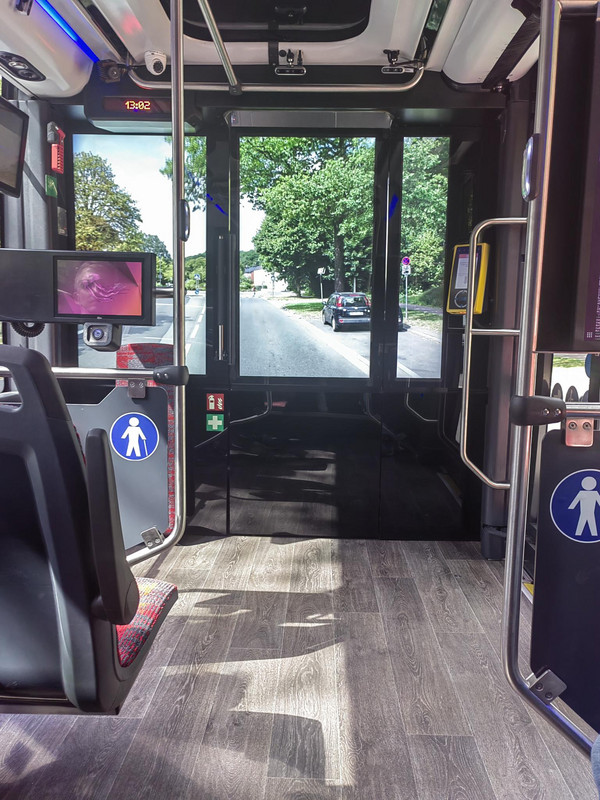
A particular focus is on the investigation of automated shuttle services. A Wizard-of-Oz shuttle is being used to research how people perceive automated vehicles, how safe they feel and which forms of communication and interaction can increase the acceptance of such services. To this end, sensor technology, digital recognition systems and communication solutions in and on the vehicle are being further developed, tested and evaluated in real-life operation.
In the BLiNKplus project, we are addressing the question of how automated and networked mobility services in rural areas can be designed to be safe, comprehensible and user-oriented. The focus is not only on the technical implementation, but above all on the interaction between the vehicle, passengers, passers-by and the surrounding area.
- Acceptance of automated mobility services
A central component of our work is investigating the acceptance of automated means of public transport. To this end, we are developing a model that describes the factors that influence people's trust, sense of security and willingness to use the system, taking into account various perspectives: People approaching the vehicle, passers-by in the vicinity of the shuttle and passengers during the journey. The transition from passer-by to passenger is particularly important - in other words, the moment when a person perceives the vehicle, approaches it, gets on board and becomes part of the mobility offer. - Development of a realistic test environment
To avoid having to test new concepts exclusively in real-life operation, we use an emulator as a laboratory environment. This simulates central functions of the vehicle and its environment. This allows sensors, data acquisition and interaction concepts to be developed, tested and optimized under controlled conditions. As part of BLiNKplus, interior and exterior sensors are installed, calibrated and connected to each other. The aim is to create a data basis that is as seamless and reliable as possible, taking into account information from both the vehicle interior and the environment. - Extension of the Wizard-of-Oz shuttle
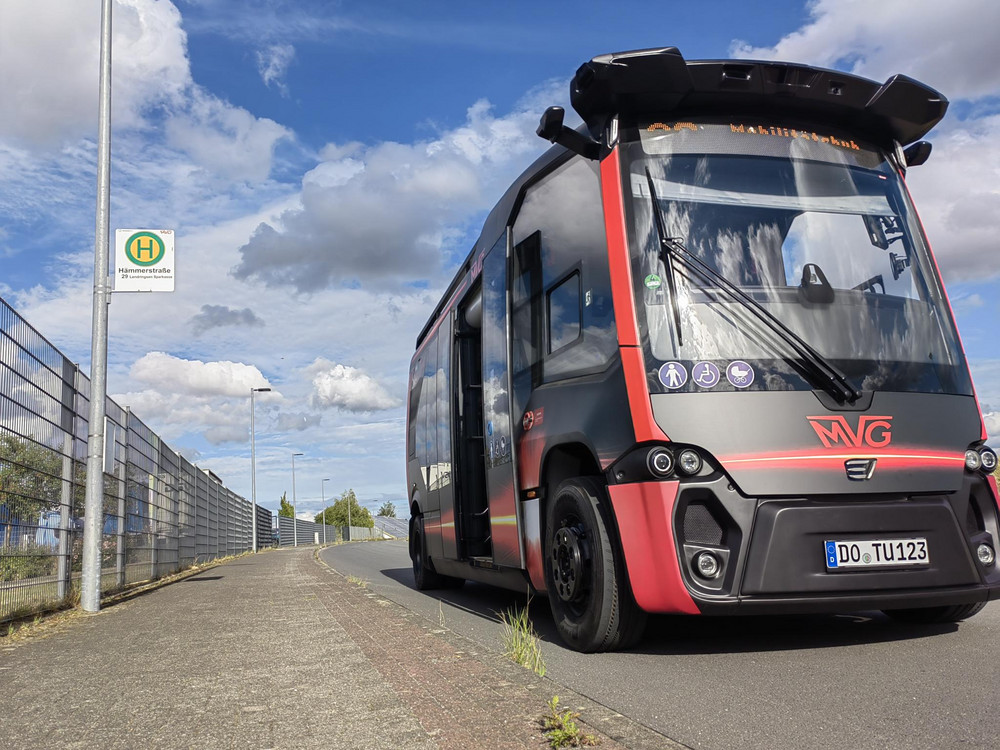
The shuttle used in the project is used as a so-called Wizard-of-Oz vehicle. This means that the vehicle can act like an automated shuttle for test persons, while certain functions are accompanied or simulated in a controlled manner. This allows realistic usage situations to be investigated without the need for fully autonomous systems. The vehicle is being technically enhanced as part of the project. This includes additional external sensors, external displays, computing technology, power supply and storage resources. These enhancements enable the vehicle's surroundings to be recorded more precisely and communication with passers-by and passengers to be more targeted. - Collecting and analyzing mobility and sensor data
Another focus is on collecting and analyzing data. We investigate how people around the vehicle can be recognized and distinguished - for example as passers-by or arriving passengers. We also look at special situations in the vehicle's surroundings, such as unexpected movements, unusual events or changes in environmental conditions. This information is important in order to better adapt the behavior of the shuttle and its communication with people to the respective situation. - Communication between the vehicle and its surroundings
For automated mobility services to be understood and accepted, the vehicle must be able to communicate clearly with its surroundings. That is why we are developing strategies for the shuttle to communicate information to the outside world. This includes, for example, information for arriving passengers about waiting or stopping times as well as information for passers-by about the upcoming departure. Passengers boarding the shuttle should also be clearly informed about the direction of travel, destination and relevant route information. This communication strategy is a functional component of the vehicle and differs from the general public relations work for the project. - Analysis of the vehicle interior
In addition to the vehicle's surroundings, we also look at the interior. The aim here is to better understand the passengers' situational awareness and attentiveness. To this end, interior sensors are used and data models are developed that can recognize different situations in the vehicle. Among other things, typical usage situations, special events in the interior and different passenger profiles are being investigated. The results will help to align automated mobility services more closely with the needs of users. - Development of interaction strategies
Based on the insights gained, we develop interaction strategies for different target groups and usage situations. In doing so, we take into account factors within the vehicle as well as external influences such as the time of day, weather conditions or special events in the surrounding area. The aim is to ensure that the vehicle reacts appropriately to the situation and communicates clearly - for example to waiting passengers, people boarding the vehicle or passers-by in the immediate vicinity. - Testing in real-life operation
The concepts developed are not only tested in the laboratory, but also in real-life operation. The focus here is on data protection and data security. In addition, drivers are trained so that interaction with the vehicle and passengers can be reliably monitored during test operations. In real operation, we are investigating how passengers perceive the shuttle, how they react to different forms of communication and interaction and which measures improve the acceptance of automated mobility. Both frequent and infrequent usage situations are considered. - Evaluation, optimization and knowledge transfer
The results from laboratory and real-life operation are systematically evaluated. On this basis, the developed models, recognition systems and interaction strategies are reviewed, further developed and optimized.