
![[Translate to English:]](/storages/rst-etit/_processed_/e/8/csm_Technologie_RST_2018_339_5719da3df9.jpg "[Translate to English:]")
TrackäR
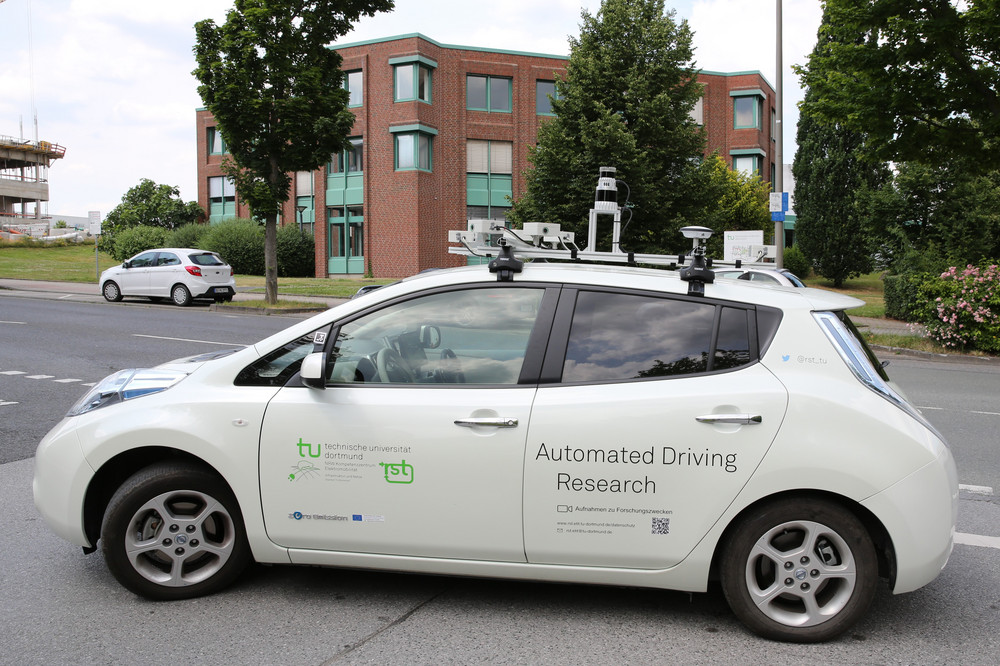
Automated driving in rural areas offers considerable potential to compensate for mobility deficits, particularly in areas where traditional public transport services cannot be operated economically. Demand-responsive services with automated minibuses are a promising option for ensuring long-term mobility in rural regions despite a lack of personnel.
At the same time, the requirements for automated driving systems in rural areas differ fundamentally from those in urban environments. A lack of lane markings, unstructured peripheral areas, changing road surfaces, agricultural traffic, livestock and wild animals or even limited visibility due to fog and darkness make it considerably more difficult to reliably perceive the surroundings. Many of the systems currently in use are based on training data from an urban context, which means that direct transferability to rural areas is not guaranteed.
In order to extend automated driving to rural areas in the future, explicitly adapted, robust and comprehensible methods for environment detection and object tracking are needed that take account of real operating conditions. Not only do new algorithmic approaches play a role here, but also the structured investigation of previous gaps in perception and the consistent consideration of uncertainties and rarely occurring but safety-critical situations.
The TrackäR project addresses precisely these challenges. Building on the unique data set for rural scenarios collected in the previous DEmandäR project, new methods for detecting and tracking objects are to be developed, evaluated under real conditions and processed in such a way that they can be seamlessly integrated into established open source frameworks for automated driving (such as ROS2 and Autoware). The aim is to create a robust technological basis for data-based, transparent and publicly usable environment detection modules in rural areas.